Beyond
the Basics…
The
classic business format model expanded over time into
more complicated forms, which allowed franchisors
to grow more rapidly and at less cost. Franchisors
created the master franchising model, which involved
the selling of development rights to third-party entities
who took over many franchisor duties. There are three
main variations to the master franchising model:
1.
Master Franchising
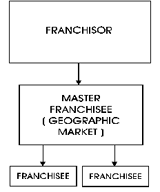
In master (or regional) franchising, the franchisor
sells the development rights in a particular market
to a master franchisee who, in turn, sells individual
franchises within the territory. The master franchisee
is responsible for attracting, screening, signing
and training all new franchisees within the territory.
Once established, on-going support is generally provided
by the parent franchisor. The master franchisee is
rewarded by sharing in the franchise fees and the
on-going royalties paid to the parent franchisor by
the franchisees within the territory.
2.
Sub-Franchising
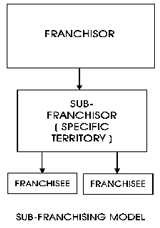
The franchisor grants development rights in a specified
territory to a sub-franchisor. After the agreement
is signed, however, the parent franchisor has no on-going
involvement with the individual franchisees in the
territory. Instead, the sub-franchisor becomes the
focal point.
All fees and royalties are paid directly to the sub-franchisor.
It is solely responsible for all recruiting, training
and on-going support, and passes on an agreed upon
percentage of all incoming fees and royalties to the
parent franchisor.
In
a sub franchising relationship, the potential franchisee
has to be doubly careful in his or her investigation.
He or she must first make sure that the sub-franchisor
has the necessary financial, managerial and marketing
skills to make the program work. Secondarily, the
potential franchisee has to feel comfortable that
the parent franchisor can be relied upon to come to
his or her rescue if the sub-franchisor should fail.
3.
Area Development
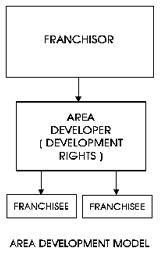
The franchisor grants exclusive development rights
for a particular geographic area to an area development
investment group. Within its territory, the area developer
may either develop individual franchise units for
its own account or find independent franchisees to
develop units. In the latter case, the area developer
has a residual equity position in the profits of its
"area franchisees."
In
return for the rights to an exclusive territory, the
area developer pays the franchisor a front-end development
fee and commits to develop a certain number of units
within a specified time period. The front-end fee
is generally significantly less than the sum of the
individual unit fees. Individual franchisees within
the territory pay all contractual franchise, royalty
and advertising fees directly to the parent franchisor.
The
area developer shares in neither the franchise fee
nor in on-going royalty or advertising fees. Instead,
the area developer shares only in the profitability
of the individual franchises that it "owns."
In essence, the area developer is buying multiple
locations over time at a discount, since the franchise
fee and (frequently) the royalty fee are less than
the per unit rate.
Next:
Franchise Lingo: Law &
Regulations
|